The Wealth Gazette

"Understanding every tool in your retirement toolbox — so you can choose the right ones."

Vol. LXII · No. 1 ♦ Special Retirement Edition ♦

Your 401(k) Was Never Designed to Replace Your Paycheck. Here Is What Was.

How a generation was quietly moved from guaranteed income to a system never designed to replace it


There is a conversation happening at kitchen tables across America that no one prepared for. It begins, usually, with a spreadsheet or a bank statement and ends with a question that has no comfortable answer: Is this going to be enough? For the 73 million Americans born between 1946 and 1964, the retirement they imagined bears startlingly little resemblance to the retirement taking shape before them.

The promise was straightforward. Work hard for thirty or forty years, collect a pension, supplement it with Social Security, and live out your years with dignity and predictability. Your parents did it. Your grandparents did it. The three-legged stool — pension, Social Security, personal savings — was not merely a financial planning concept. It was a social contract.

That contract was rewritten without most people noticing. In 1980, roughly 38 percent of private-sector workers had a defined-benefit pension. Today, that number has fallen below 15 percent, and it continues to shrink. The pension did not disappear overnight. It was replaced, gradually and deliberately, by the 401(k) — a vehicle that shifted every ounce of investment risk from the employer to the employee.

Here is what almost no one was told at the time: the 401(k) was never designed to be a primary retirement vehicle. It originated as a supplemental savings provision in the Revenue Act of 1978, intended for corporate executives who wanted to defer bonuses. Benefits consultant Ted Benna saw a loophole and popularized it, but even he has publicly expressed regret. "I would blow up the system and restart with something totally different," Benna told The Wall Street Journal in 2011.

The distinction matters enormously. A pension pays you a guaranteed amount every month for life, regardless of what the stock market does. A 401(k) gives you a pile of money and says, essentially, "Good luck — try to make this last 25 to 30 years." One is an income. The other is a balance. And the psychological difference between receiving a paycheck and watching a balance decline is something most retirees describe as profoundly unsettling.

To be fair, the 401(k) has genuine advantages. It is portable. It offers investment flexibility. And for disciplined savers who started early in a long bull market, it has created real wealth. But those advantages come with a trade-off that is rarely discussed honestly: you are now your own pension manager, responsible for asset allocation, withdrawal strategy, tax planning, and longevity risk — disciplines that take professional advisors years to master.

The numbers tell the story plainly. According to the Federal Reserve's Survey of Consumer Finances, the median 401(k) balance for households aged 55 to 64 is approximately $185,000. Even with Social Security, that figure leaves a gap that optimism alone cannot bridge. At a conservative four-percent withdrawal rate, $185,000 generates roughly $7,400 per year — about $617 per month.

None of this is meant to alarm. It is meant to clarify. The first step toward a secure retirement is understanding the system you are actually operating within — not the one you were promised. In the editions ahead, we will examine the specific risks, blind spots, and opportunities that define retirement planning today. Because the retirement you want is still possible. It simply requires a different map than the one you were given.
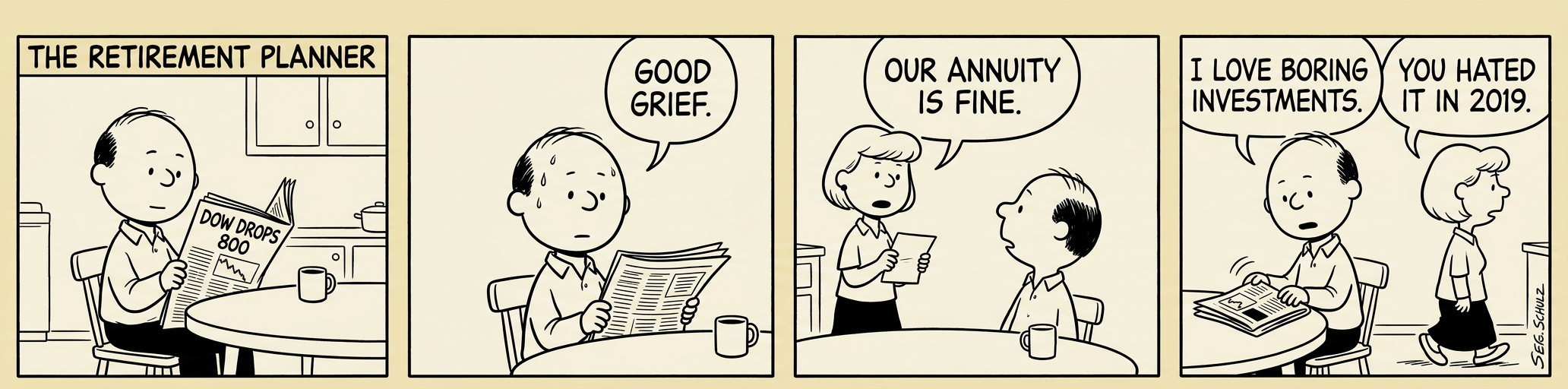
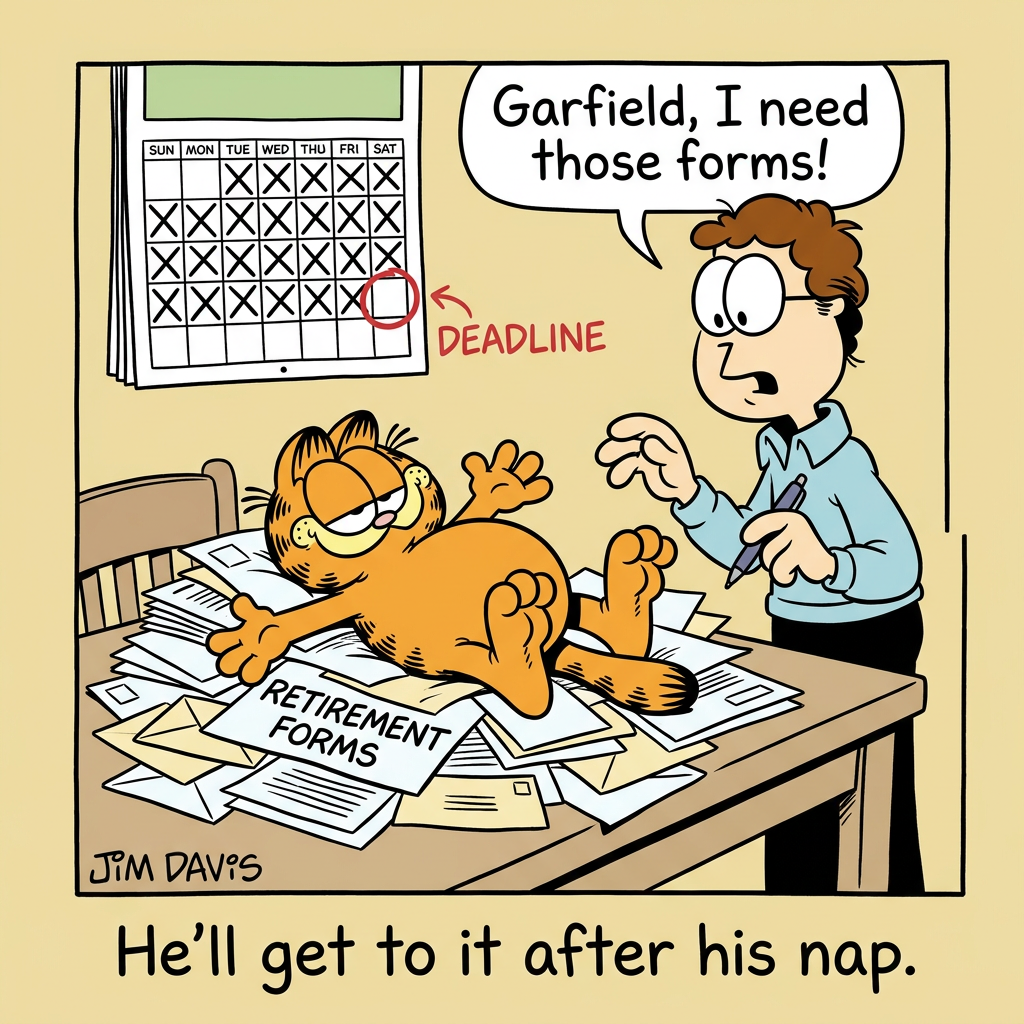
The Lighter Side of Compound Interest

A comic strip in four panels

Panel 1: A young man in a 1980s office receives a pamphlet titled 'Your New 401(k) Plan!' and looks confused. Panel 2: Now middle-aged, he stares at a pie chart on his computer screen while eating lunch at his desk. Panel 3: At age 62, he sits across from a financial advisor who is gesturing at a chart that clearly goes down. Panel 4: He is back at the kitchen table with his wife, both squinting at a calculator, with the pamphlet from Panel 1 pinned to the refrigerator behind them, now yellowed with age.

The Three-Legged Stool Was Missing a Leg Before You Sat Down


For decades, financial literacy courses taught the "three-legged stool" of retirement: employer pension, Social Security, and personal savings. It was a tidy metaphor. It was also, for most Americans, a fiction by the time they needed it.

With pensions largely eliminated, the stool now rests on two legs — Social Security and personal savings — and one of those legs is under pressure. The Social Security Trustees' 2024 report projects the combined trust funds will be depleted by 2035, after which the system can pay approximately 83 percent of scheduled benefits.

This does not mean Social Security will vanish. It means the benefit you planned around may be smaller than you assumed. For someone expecting $2,400 per month, an 17-percent reduction translates to roughly $400 less — every month, for life.

The practical takeaway is uncomfortable but important: if your retirement plan depends on all three legs being sturdy, it is time to test each one individually. The stool metaphor was useful. The question is whether it still describes your reality.


Editor's Pick

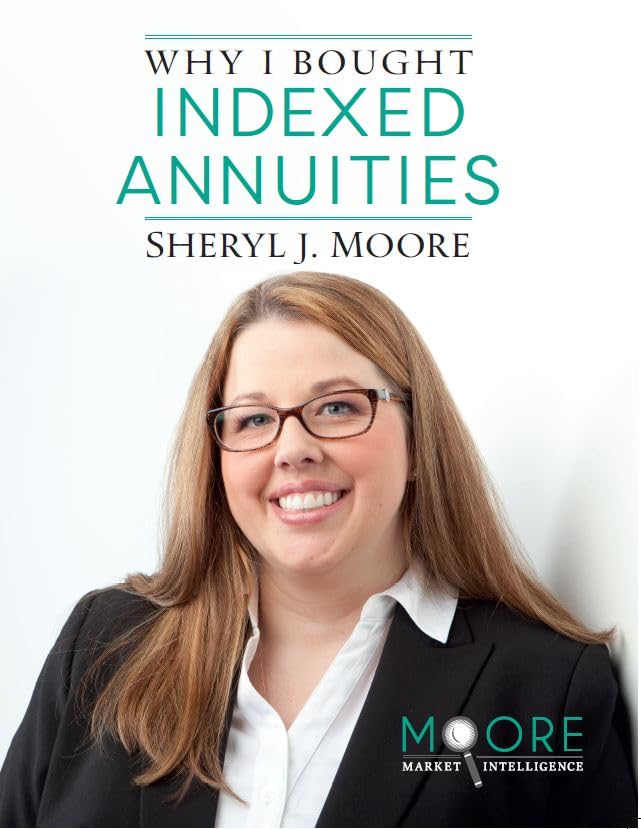
"Why I Bought Indexed Annuities"

Written by an independent industry analyst with no incentive to sell you anything — just a straightforward look at why she chose indexed annuities, what surprised her, and what she wishes more people understood. For readers who want facts, not a sales pitch.

Why I Bought Indexed Annuities - Free Book

Request Your Free Copy Below — No Cost, No Catch

Editorial Cartoons

Editorial cartoon: A man in a suit balances on a stool with only two legs, labeled 'Social Security' and 'Savings.' The missing third leg, labeled 'Pension,' lies broken on the floor. A sign on the wall reads 'Retirement Planning Office.' The man says, 'They told me to have a seat.'
Editorial cartoon: A giant hand labeled 'Corporate America' places a 401(k) statement into the hands of a bewildered retiree standing at the edge of a cliff labeled '30 Years of Retirement.' The retiree holds a tiny umbrella labeled '$185,000.' Storm clouds gather overhead.

Extra! Extra!

Your Next Steps


  1. If you received this by email: Navigate back and click the booking link to schedule your free 60-minute education session.
  2. If you received this by text: Reply to your advisor and share what stood out to you. They will take it from there.
  3. Show up to your free education session. No obligations, no sales pitch — just annuity basics and answers to your questions.
  4. Receive your complimentary copy of "Why I Bought Indexed Annuities" — our way of saying thanks for your time.

"Education first. Decisions second. Always."


Classifieds

WANTED: One retirement matching the brochure shown at the 1987 company orientation. Will accept reasonable facsimile. Must include "guaranteed" and "worry-free" as originally advertised. Contact: Every American Over 55.

Public Notices

NOTICE: The Bureau of Retirement Expectations wishes to inform the public that the phrase "Freedom 55" has been reclassified from "planning target" to "historical fiction." All references should be updated accordingly in personal financial documents.

Financial Forecast

OUTLOOK: The retirement confidence gap — the distance between what Americans believe they need and what they have actually saved — continues to widen. The Employee Benefit Research Institute's 2024 Retirement Confidence Survey found that fewer than one in four workers describe themselves as "very confident" about having enough money for a comfortable retirement. Markets remain unpredictable; planning remains essential.