Richard Calloway retired in January 2008 with $2.7 million in a diversified stock portfolio and a confidence born of three decades of disciplined saving. His financial plan projected comfortable withdrawals of $135,000 per year -- roughly five percent of his total nest egg. By every conventional measure, he had done everything right. Within fourteen months, his portfolio had lost nearly $920,000 in market value, and those same withdrawals were now consuming a dangerously larger share of a rapidly shrinking balance.
This is the story of sequence-of-returns risk, and it is one of the most consequential -- and least discussed -- threats facing retirees with substantial savings. The concept is deceptively simple: the order in which investment returns occur matters far more in retirement than the average return over time. A retiree who experiences poor returns early, while simultaneously drawing income, can permanently impair a portfolio that would have thrived under identical average returns in a different sequence.
What makes this risk so insidious is that it punishes the disciplined saver and the reckless spender in precisely the same way. Richard had no debt. He lived modestly relative to his means. He had followed the standard advice for decades. But the standard advice had never fully accounted for what happens when you begin removing money from a portfolio during a prolonged decline.
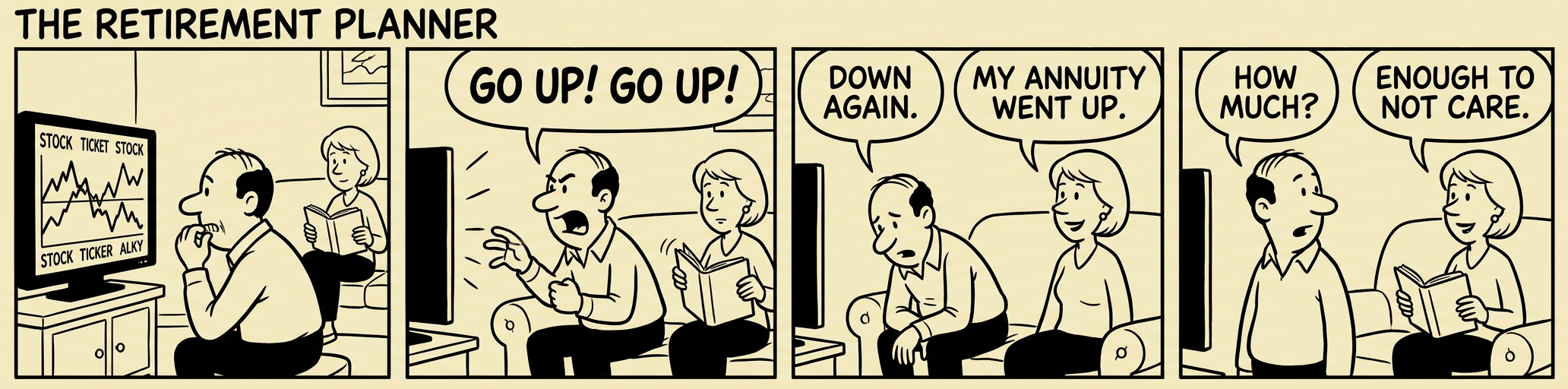
Richard's advisor eventually recommended a partial reallocation: roughly thirty percent of his remaining portfolio was repositioned into a fixed indexed annuity with an income rider. This was not a move Richard made enthusiastically. He had spent his career believing that the market, given enough time, would always recover. But retirement had changed the equation. He no longer had time as an ally. He needed a portion of his income to arrive regardless of what the S&P 500 did next quarter.
The annuity did what it was designed to do. It provided a predictable income floor -- roughly $42,000 per year -- that allowed Richard to reduce his withdrawals from the remaining invested portfolio. That reduction gave his equities the breathing room to recover without being depleted by forced selling during down markets. By 2014, his combined assets had recovered to approximately $2.4 million, and his guaranteed income stream remained intact.
Here is the trade-off that deserves honest acknowledgment: Richard sacrificed liquidity and some growth potential on that thirty percent allocation. The annuity portion of his portfolio will never match a roaring bull market. That is the cost of certainty. But Richard will also tell you that certainty is what allowed him to sleep through the corrections of 2011, 2018, and 2020 without panic-selling a single share.
The lesson is not that everyone with $2.7 million needs an annuity. The lesson is that even substantial wealth is vulnerable to timing -- and that a retirement plan built entirely on market performance is a plan that assumes the future will be kind. Sometimes it is. Sometimes it is not. The difference between a good retirement and a devastating one can be as simple as which year you happen to stop working.
Richard Calloway did not need more money. He needed a strategy that acknowledged what he could not control. That distinction is worth more than any rate of return.