The Wealth Gazette

"Understanding every tool in your retirement toolbox — so you can choose the right ones."

Vol. LXII · No. 18 ♦ Action Series ♦

The Market Will Crash Again. The Only Question Is When.

History is unambiguous: downturns are inevitable. The only variable is whether your retirement plan survives them.


Since 1929, the United States stock market has experienced 26 bear markets. That is roughly one every 3.6 years. Each one felt unprecedented at the time. Each one was followed by recovery. And each one devastated the retirement plans of people who were not positioned for it — not because they were foolish, but because nobody had explained the difference between accumulating wealth and protecting it.

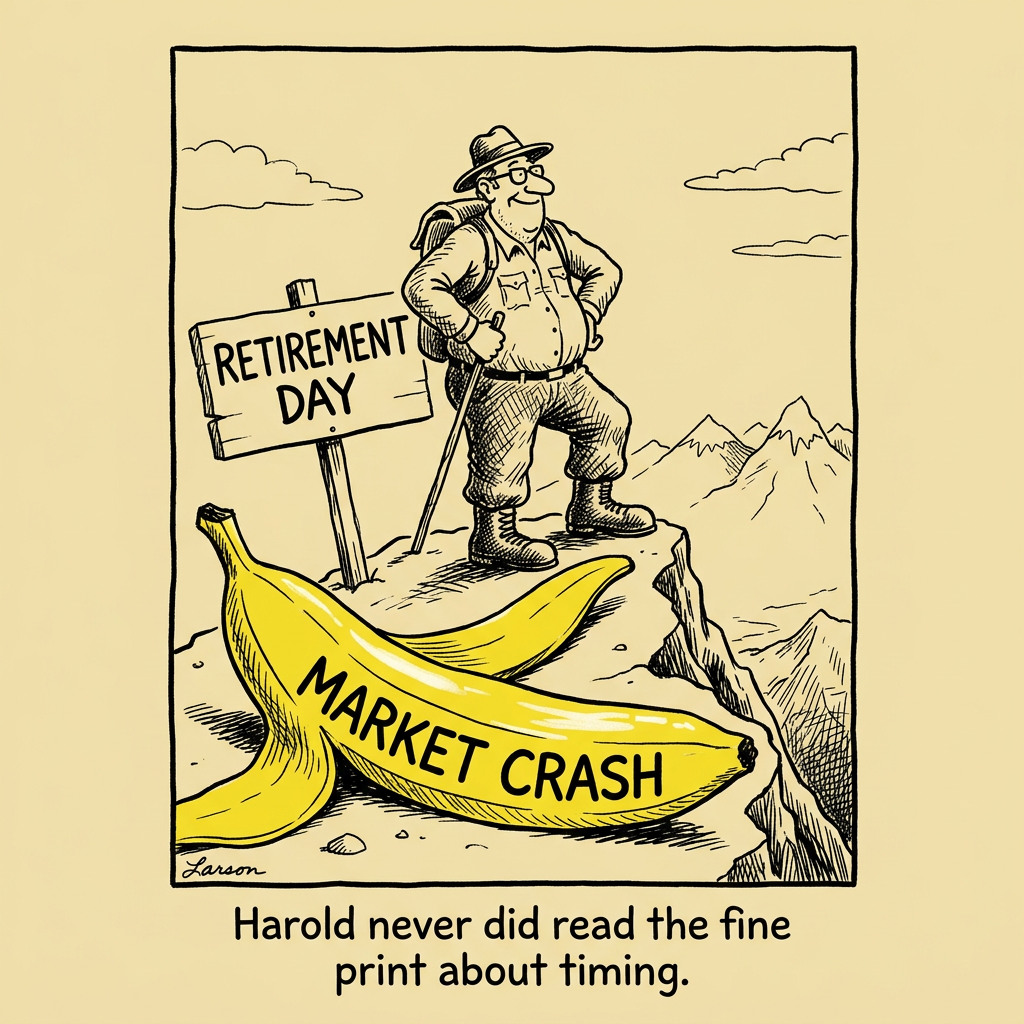
When you are 35 and the market drops 40%, you have three decades of future earnings and compounding to recover. The math works in your favor. Time is your ally. But when you are 64 and the market drops 40%, the math changes completely. You do not have decades. You have months or years. And if you are withdrawing from that portfolio to fund your living expenses, you are selling shares at depressed prices — permanently locking in losses that your portfolio may never recoup.

Financial planners call this "sequence of returns risk," and it is the single most dangerous concept in retirement finance that most people have never heard of. It means that the order in which you experience market returns matters far more than the average return over time. Two retirees with identical portfolios and identical average returns over 25 years can have wildly different outcomes based solely on whether the bad years came early or late.

Here is a concrete example. If you retire with $1,000,000 and withdraw $50,000 per year, and the market drops 30% in your first year of retirement, your portfolio falls to $650,000 after that withdrawal. Even if the market recovers fully over the next several years, you have permanently reduced the base from which your investments can grow. By contrast, if that same 30% drop happens in year 15 instead of year 1, the impact on your long-term portfolio survival is dramatically smaller.

The trade-off that honest financial planning requires you to confront is this: protecting against market crashes in retirement means accepting lower average returns during good years. There is no free lunch. A portfolio structured to withstand a bear market in your first year of retirement will not grow as aggressively during bull markets. You are exchanging upside potential for downside protection — and for a retiree who cannot afford to lose 40% of their nest egg, that exchange is often the right one.

The approach that works for most retirees is not about predicting crashes or timing markets. It is about building a retirement income structure where your essential expenses — housing, food, healthcare, utilities — are covered by income sources that do not depend on market performance. Social Security, pensions, and certain types of annuity contracts can serve this function. When those essentials are covered, market volatility becomes something you observe rather than something that threatens your ability to eat.

The mistake most people make is assuming that because markets always recover, their retirement will always recover too. Markets recover because they are abstract mathematical constructs with unlimited time horizons. Your retirement is not abstract. It has a very specific, very human timeline. The market can afford to wait ten years for recovery. The question is whether you can.

Positioning your finances so that a market crash is an inconvenience rather than a catastrophe is not pessimism. It is the most clear-eyed form of optimism available: the belief that your retirement is worth protecting, even from events you cannot predict.

Bear Necessities

A comic strip in four panels

Panel 1: A retiree watches a stock ticker going up, up, up. He says 'Retirement will be easy — just ride the market!' Panel 2: A literal bear wearing a Wall Street vest appears behind him, tapping his shoulder. Panel 3: The ticker plunges. The retiree's coffee mug reads 'THIS IS FINE.' His portfolio statement reads '-38%.' Panel 4: Split scene — left side shows a panicked retiree selling everything at the bottom; right side shows a calm retiree reading the Gazette, sipping tea, with a sign on her desk reading 'ESSENTIAL EXPENSES COVERED. BRING IT.' Caption: 'Same bear. Different preparation.'

Crash-Proofing Your Retirement Income: What Actually Works


The goal of crash-proofing is not to avoid market exposure entirely. That would mean accepting returns that barely keep pace with inflation. The goal is to structure your retirement so that essential expenses are covered by reliable, non-market-dependent income — regardless of what the stock market does on any given Tuesday.

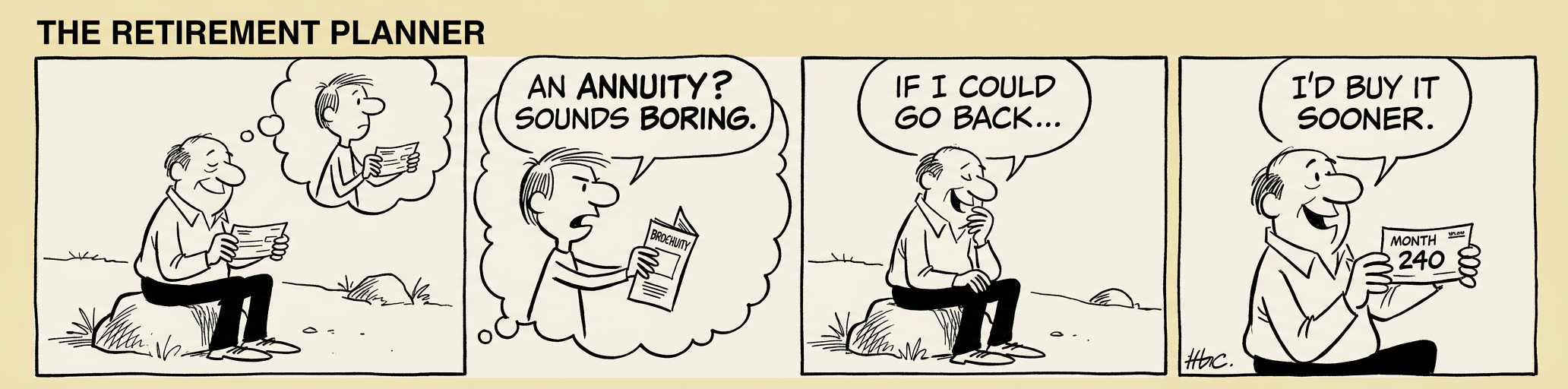
Think of it as building a floor. Social Security provides one layer. A pension, if you have one, adds another. Certain annuity contracts can guarantee a minimum income stream that continues even when markets decline. Once your floor covers your non-negotiable expenses — housing, food, healthcare, insurance — you can afford to keep a portion of your savings invested in the market for growth, because you are not depending on those investments to survive.

The trade-off is straightforward: money allocated to guaranteed income sources typically grows more slowly than money in the open market. You are giving up potential gains in exchange for certainty. For a 40-year-old with decades ahead, that trade makes less sense. For a 62-year-old who cannot afford to lose half their nest egg two years before retirement, it can be the most rational financial decision available.

There is no single product or strategy that works for everyone. The right mix of market exposure and guaranteed income depends on your specific expenses, your other income sources, your health, and your tolerance for uncertainty. What matters most is having the conversation before the next crash — not during it.

History suggests the next bear market is not a question of "if" but "when." The retirees who navigate it successfully will be the ones who planned for it while the skies were still clear.


Editor's Pick

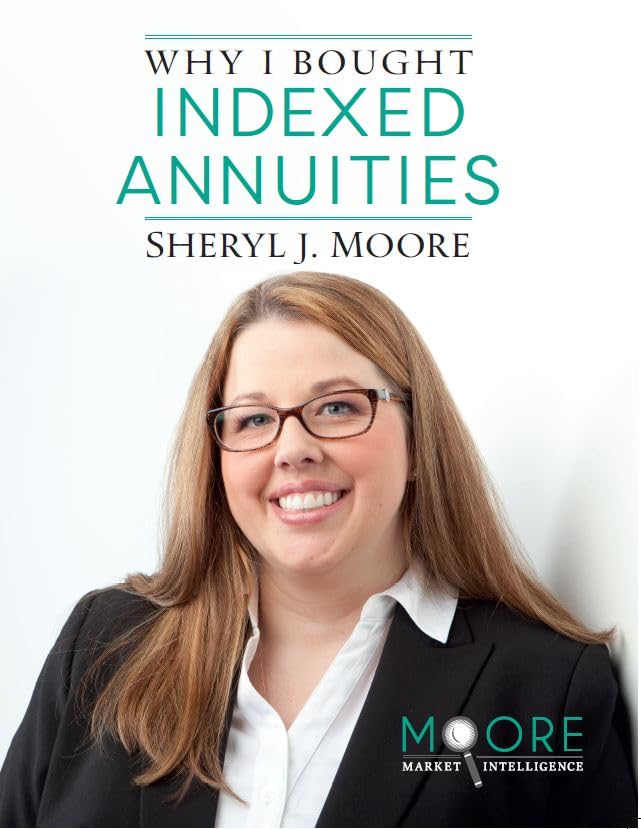
"Why I Bought Indexed Annuities"

Written by an independent industry analyst with no incentive to sell you anything — just a straightforward look at why she chose indexed annuities, what surprised her, and what she wishes more people understood. For readers who want facts, not a sales pitch.

Why I Bought Indexed Annuities - Free Book

Request Your Free Copy Below — No Cost, No Catch

Editorial Cartoons

A roller coaster labeled 'S&P 500' with two riders. The 35-year-old in the front car has arms raised, laughing. The 65-year-old in the back car is white-knuckled, watching dollar bills fly out of his pockets on every drop. Caption: 'Same ride. Different stakes.'
A house built on two layers. The foundation is labeled 'GUARANTEED INCOME: Social Security, Pension, Annuities' and is made of solid stone. The upper floors are labeled 'MARKET INVESTMENTS' and are made of playing cards. A strong wind blows the cards around while the foundation stays firm. Caption: 'Build the floor first.'

Extra! Extra!

Your Next Steps


  1. If you received this by email: Navigate back and click the booking link to schedule your free 60-minute education session.
  2. If you received this by text: Reply to your advisor and share what stood out to you. They will take it from there.
  3. Show up to your free education session. No obligations, no sales pitch — just annuity basics and answers to your questions.
  4. Receive your complimentary copy of "Why I Bought Indexed Annuities" — our way of saying thanks for your time.

"Education first. Decisions second. Always."


Classifieds

FOR SALE: Crystal ball, previously used for market timing. Accuracy rate: 0%. Has correctly predicted 14 of the last 3 recessions. Comes with complimentary bottle of antacid and a subscription to financial cable news. Serious inquiries only.

Public Notices

NOTICE: The phrase "the market always comes back" is historically accurate for indices and mathematically irrelevant for retirees making withdrawals during downturns. The Wealth Gazette encourages readers to learn the difference between market recovery and portfolio recovery before the next bear market provides an involuntary lesson.

Financial Forecast

OUTLOOK: Current market valuations remain elevated by historical standards. This is not a prediction of imminent decline — it is an observation that the conditions under which crashes occur (high valuations, investor complacency, unexpected catalysts) are always present to some degree. The prudent response is preparation, not prediction.