The Wealth Gazette

"Understanding every tool in your retirement toolbox — so you can choose the right ones."

Vol. LXII · No. 19 ♦ Action Series ♦

The Five Retirement Questions Everyone Wishes They Had Asked Ten Years Sooner

Inside the education session: what actually happens, what to bring, and why 83% of attendees say they learned something they did not expect


Most people imagine a financial meeting as a high-pressure sales presentation. Someone in a suit slides a glossy brochure across a conference table, points to a product, and asks you to sign. That image is not entirely unfounded — it describes a meaningful portion of the financial services industry. It also has nothing to do with what we are talking about here.

An education session is exactly what the name implies. You sit down for 60 minutes with someone whose job, in that meeting, is not to sell you anything. It is to show you where you stand, explain what tools exist, and answer whatever questions you bring. The meeting ends when the hour is up. There is no contract. There is no close. There is no second person who enters the room to "help with the paperwork."

What happens in those 60 minutes varies based on what you need, but the structure is consistent. The first fifteen minutes are about you: your current situation, your income sources, your concerns, your goals. Not a questionnaire — a conversation. The advisor is listening for the gaps between what you know and what you need to know. Everyone has them. The gaps are not a sign of failure. They are the natural result of spending your career focused on your career instead of on retirement planning.

The middle portion of the meeting is where the value gaps become visible. This is where people discover that their Social Security timing decision could mean a difference of $80,000 over their lifetime. Or that their current tax strategy is leaving money on the table every year. Or that their beneficiary designations have not been updated since their first marriage. These are not obscure financial details. They are fundamental questions that affect every dollar of retirement income, and most people have never had anyone walk them through the answers.

The final fifteen minutes are about questions. Not your questions for the advisor — though those are welcome — but the questions the advisor has surfaced for you. Things to think about, look up, discuss with your spouse. Many people leave the meeting with more questions than they came in with, and that is by design. Better questions lead to better decisions. The goal is not to give you answers in 60 minutes. The goal is to make sure you are asking the right questions for the next 30 years.

The honest trade-off is your time. Sixty minutes is not trivial, especially if you are skeptical. You may spend the first ten minutes waiting for the sales pitch that never comes. That wariness is understandable and, frankly, healthy. The financial services industry has earned the skepticism it receives. All we can tell you is what this particular meeting is not: it is not a pitch, not a close, and not an obligation.

What to bring is simple: your most recent Social Security statement (available at ssa.gov), a rough sense of your monthly expenses, and any questions you have been carrying around. You do not need to bring financial statements, tax returns, or any documents you are not comfortable sharing. The meeting works with whatever you provide.

The 83% figure in the headline comes from post-session surveys conducted over the past two years. When asked, "Did you learn something you did not previously know about your retirement finances?" more than four out of five respondents said yes. The most common response was a variation of: "I did not know what I did not know." That sentence, more than any statistic, explains why these meetings exist.
The Waiting Room

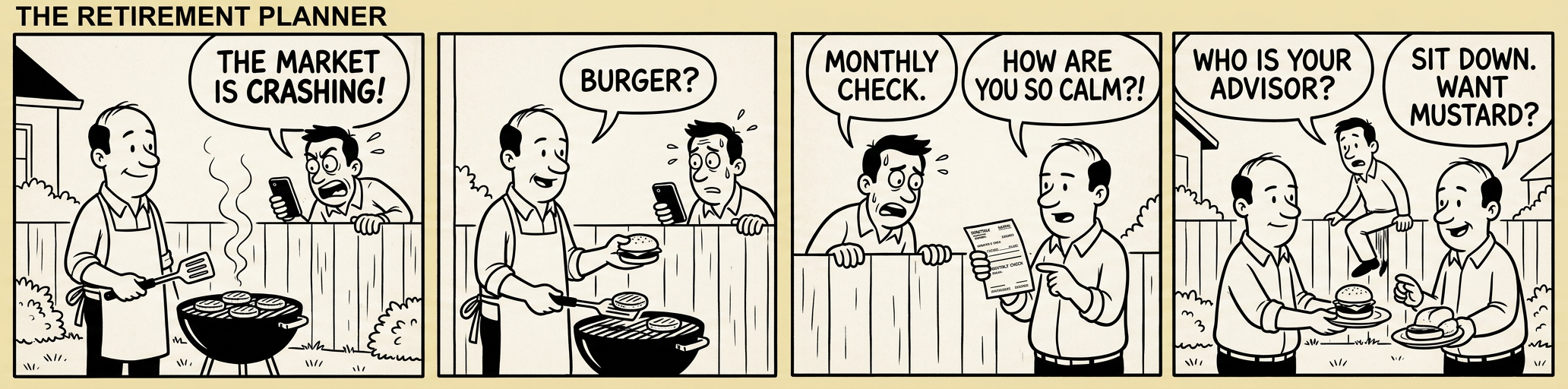
A comic strip in four panels

Panel 1: A nervous retiree sits in a waiting room, sweating. A thought bubble reads: 'They are going to try to sell me something. I just know it.' Panel 2: The advisor walks in with a whiteboard marker and a cup of coffee, saying 'So, tell me about your retirement goals.' Panel 3: Forty-five minutes later, the retiree is leaning forward, pointing at a diagram on the whiteboard, saying 'Wait — so THAT is how Social Security taxation works?' Panel 4: The retiree walks out, calling his spouse on the phone: 'Honey, we need to talk. Not in a bad way. In a we-have-been-leaving-money-on-the-table way.'

The Five Questions Most People Wish They Had Asked Sooner


After surveying hundreds of retirees about their biggest financial regrets, five questions emerged that respondents wished they had asked — and answered — years earlier. None of them are complicated. All of them are consequential.

1. "What happens to my spouse's income if I die first?" The surviving spouse penalty (loss of one Social Security check, shift to single tax filing) catches most couples by surprise. Running the numbers before it happens is the only way to prepare for it.

2. "Am I taking Social Security at the right time?" The difference between claiming at 62 versus 70 can exceed $100,000 in lifetime benefits. Most people claim early without understanding what they are leaving behind.

3. "What is my actual tax bracket in retirement, and will it change?" Many retirees assume their taxes will be lower in retirement. For those with substantial retirement account balances, the opposite is often true once RMDs begin.

4. "How much of my savings can I safely spend each year without running out?" The answer is almost never a simple percentage. It depends on your age, your other income, your investment mix, and when the next bear market arrives. Most people either spend too cautiously (sacrificing quality of life) or too aggressively (risking depletion).

5. "Do I have a plan, or do I just have accounts?" Having a 401(k), an IRA, and a brokerage account is not the same as having a retirement plan. A plan coordinates all of those accounts into a coherent strategy with clear answers to the questions above. Most people have accounts. Far fewer have a plan.


Editor's Pick

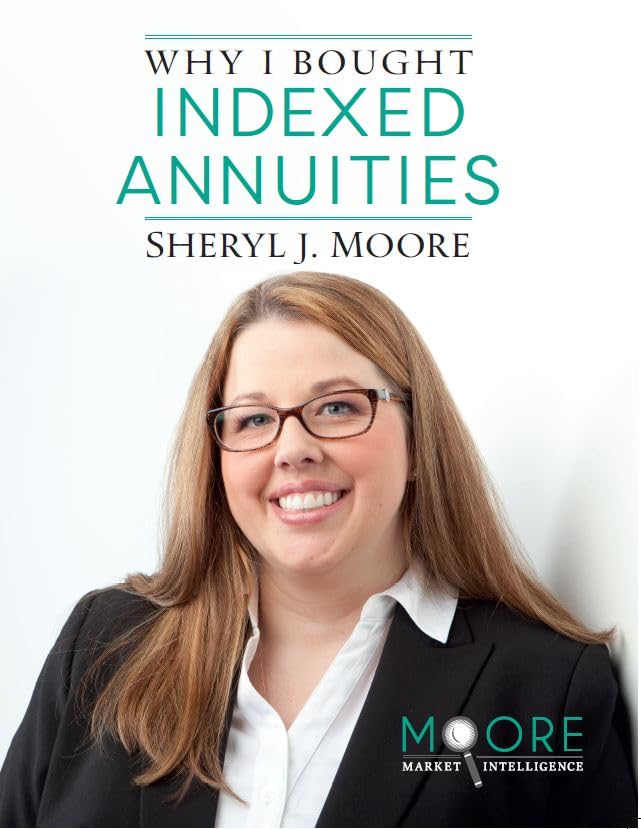
"Why I Bought Indexed Annuities"

Written by an independent industry analyst with no incentive to sell you anything — just a straightforward look at why she chose indexed annuities, what surprised her, and what she wishes more people understood. For readers who want facts, not a sales pitch.

Why I Bought Indexed Annuities - Free Book

Request Your Free Copy Below — No Cost, No Catch

Editorial Cartoons

A person stands at a crossroads. One path is labeled 'KEEP WONDERING' and stretches into a fog. The other is labeled '60 MINUTES OF CLARITY' and leads to a well-lit landscape with visible mile markers labeled 'Social Security,' 'Tax Plan,' 'Income Floor,' and 'Legacy.' The person's shoes are pointed toward the fog, but their head is turned toward the light. Caption: 'The hardest step is the first one.'
A doctor's office scene, but instead of a medical chart, the wall displays a retirement income projection. The 'patient' sits on the exam table looking surprised. The 'doctor' (financial educator) says: 'The good news is we caught it early. The gap in your plan is entirely treatable.' Caption: 'A financial check-up.'

Extra! Extra!

Your Next Steps


  1. If you received this by email: Navigate back and click the booking link to schedule your free 60-minute education session.
  2. If you received this by text: Reply to your advisor and share what stood out to you. They will take it from there.
  3. Show up to your free education session. No obligations, no sales pitch — just annuity basics and answers to your questions.
  4. Receive your complimentary copy of "Why I Bought Indexed Annuities" — our way of saying thanks for your time.

"Education first. Decisions second. Always."


Classifieds

WANTED: Sixty minutes of courage. Must be willing to sit in a chair, listen to information about your own retirement, and resist the urge to check your phone. No prior experience with financial conversations required. Sweaty palms acceptable. Side effects may include clarity, relief, and mild irritation that you did not do this sooner.

Public Notices

NOTICE: The education session described in this edition involves no fees, no contracts, and no obligation of any kind. Attendees leave with information, not invoices. The Wealth Gazette has confirmed this policy and will continue to hold it to account. Readers who experience otherwise are encouraged to report their experience immediately.

Financial Forecast

OUTLOOK: The current interest rate environment continues to offer historically favorable conditions for certain retirement income strategies, including fixed and indexed annuity contracts. These conditions are not permanent. Readers who have been considering a review of their retirement income plan may find the present moment more favorable than what follows.