Richard and Patricia Owens did everything right. They saved steadily for 32 years, maxed out their 401(k) contributions, diversified across large-cap, small-cap, and international funds, and entered 2008 with a portfolio worth $840,000. Their financial plan called for a comfortable withdrawal of $3,500 per month. By March of 2009, their portfolio had fallen to $588,000. They had lost $252,000 — thirty percent of everything — in roughly 16 months.
Here is the part that kept them awake at night: to get back to $840,000, they did not need a 30 percent gain. They needed a 43 percent gain. This is not a rounding error. It is a fundamental asymmetry in how losses and gains actually work, and it is one of the most consequential mathematical facts in all of retirement planning.
The arithmetic is ruthless in its simplicity. If you start with $100 and lose 50 percent, you have $50. To return to $100, you need to double your money — a 100 percent gain. A 30 percent loss requires a 43 percent gain to recover. A 40 percent loss demands a 67 percent gain. The deeper the hole, the steeper the climb. Wall Street calls this "volatility drag." Retirees call it devastating.
For someone still working and contributing, time is the remedy. The Owens' children, both in their thirties, barely noticed the 2008 crash in their own 401(k)s. They were buying shares at discounted prices and had decades for recovery. But Richard was 63 and Patricia was 61. They were not adding to their portfolio. They were drawing from it. Every month they withdrew $3,500, the balance had less capital to participate in any recovery.
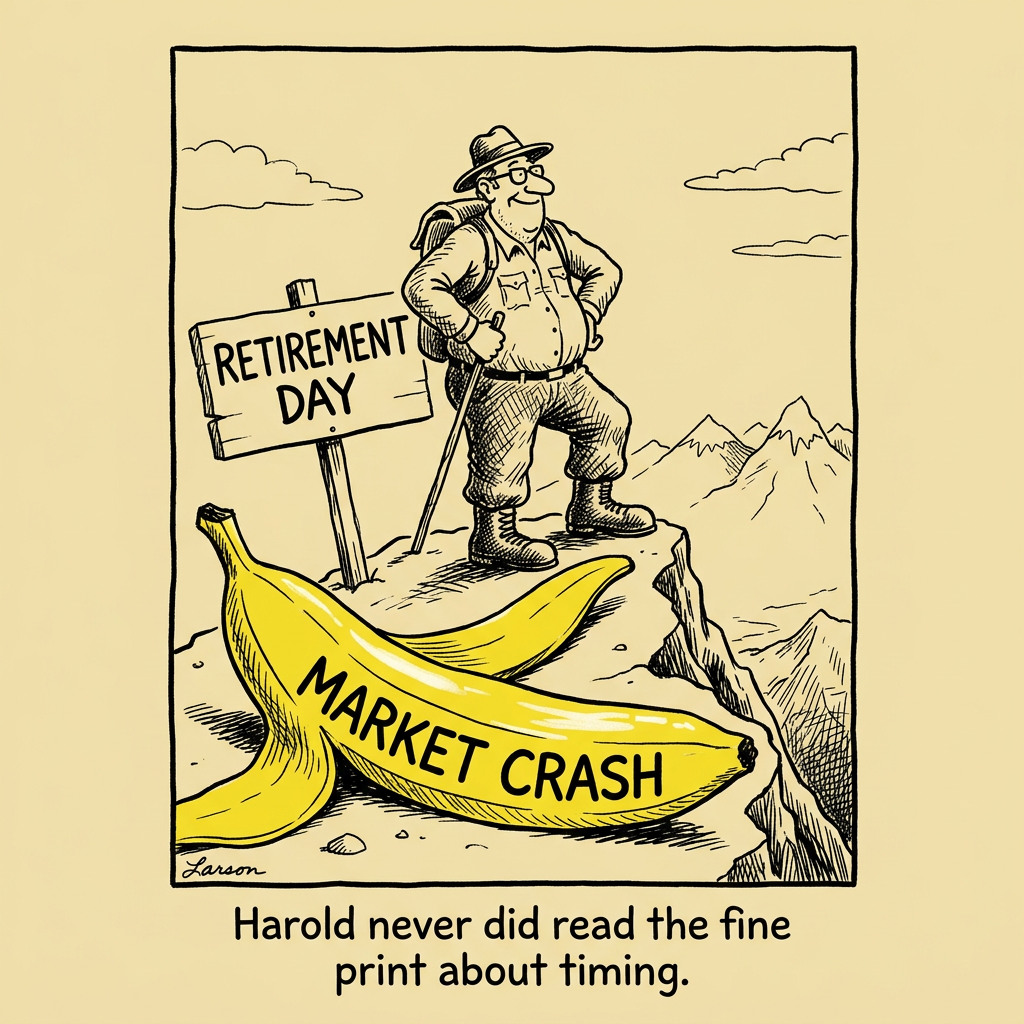
This is the cruel paradox of retirement-age investing: the market does not know you are retired. It does not care that you need $3,500 next month. It does not adjust its timeline to match yours. And when a downturn arrives in the early years of retirement — precisely when your portfolio is at its largest and most vulnerable — the damage can permanently alter the trajectory of your financial life.
To their credit, Richard and Patricia did not panic-sell at the bottom. Many did. Fidelity reported that roughly one in four participants over age 55 reduced their equity allocation during the crisis, often locking in losses at the worst possible moment. The emotional pull to "stop the bleeding" is almost irresistible when you are watching decades of work evaporate on a screen.
It is also worth noting what volatility drag does not mean: it does not mean the stock market is a bad investment. Over long periods, equities have delivered returns that outpace inflation, bonds, and cash. The issue is not whether the market goes up over time. It almost certainly will. The issue is whether your money can survive the path it takes to get there — especially when you are withdrawing from it along the way.
The Owens eventually recovered their portfolio value by late 2012 — nearly four years later. But those four years of withdrawals during recovery meant their real purchasing power never fully returned. They adjusted. They traveled less. They helped their grandchildren less than they had planned. The math recovered. The lifestyle did not. Their story is not unusual. It is, increasingly, the norm.