The Wealth Gazette

"Understanding every tool in your retirement toolbox — so you can choose the right ones."

Vol. LXII · No. 5 ♦ Psychology of Retirement Special Report ♦

Most Retirees Fear Running Out of Money. Few Will Ever Say It Out Loud.

The fears no spreadsheet captures — and why the emotional side of retirement planning may matter more than the math


At 3:14 on a Tuesday morning, Robert Haines, 71, is sitting at his kitchen table in the dark. He is not hungry. He is not restless. He is doing arithmetic. Specifically, he is calculating whether his savings will outlive him or he will outlive his savings. He has done this calculation before — many times, always at night, always alone. The numbers change slightly each time, depending on which assumptions he uses. The dread does not change at all.

Robert has $612,000 in retirement savings, a Social Security benefit of $2,840 per month, and no pension. By any historical standard, he is in better shape than most Americans his age. He knows this. It does not help. "During the day, I can be rational about it," he says. "At night, rational goes to sleep and fear takes over."

He is not alone in this. A 2024 survey by the National Institute on Retirement Security found that more than half of Americans report feeling anxious about their financial future in retirement — and that includes people who, by objective measures, have adequate savings. The gap between having enough and feeling like you have enough turns out to be vast, persistent, and remarkably resistant to spreadsheets.

The fears tend to cluster around three themes, and they are worth naming honestly. The first is outliving their money — the classic longevity risk that financial planners discuss in technical terms but retirees experience as a raw, visceral fear of poverty in old age. The second is becoming a burden — needing care, losing independence, relying on children who have their own financial pressures. The third, and perhaps the most corrosive, is trusting the wrong person — handing their life savings to an advisor who does not have their best interests at heart.

That third fear deserves particular attention because it creates a dangerous paralysis. Americans over 60 lose an estimated $28.3 billion annually to financial fraud and exploitation, according to AARP's 2023 report. High-profile scandals involving conflicts of interest have conditioned an entire generation to be suspicious of financial advice — sometimes justifiably, sometimes to their own detriment. The result is a population that needs guidance more than ever but trusts guidance less than ever.

Here is the uncomfortable trade-off: the fear of being taken advantage of can itself become a financial risk. Retirees who avoid all professional advice out of distrust often make costlier mistakes than the fees they were trying to avoid — poor tax planning, suboptimal Social Security claiming strategies, inadequate insurance, and portfolios that are either too aggressive or too conservative for their actual situation. Skepticism is healthy. Paralysis is not.

Psychologist Dr. Linda Holcomb, who specializes in retirement transitions, describes the 3 AM phenomenon as "anticipatory grief for a life you haven't lost yet." Unlike the concrete problems of market risk or inflation, this anxiety operates in the realm of what-if. What if the market crashes again? What if I get sick? What if my advisor is not who they say they are? What if I made the wrong choice 20 years ago and it is too late to fix it? Each question is reasonable. Together, at 3 AM, they form a weight that no amount of money fully removes.

The retirees who sleep best, research consistently shows, are not necessarily the wealthiest. They are the ones who have converted uncertainty into structure: a written plan they understand, income they can count on, and a relationship with an advisor they have vetted thoroughly — someone who explains the downsides, acknowledges what they do not know, and earns trust through transparency rather than promises. Robert Haines is working on getting there. He has started asking better questions. And some nights, he sleeps until 5.
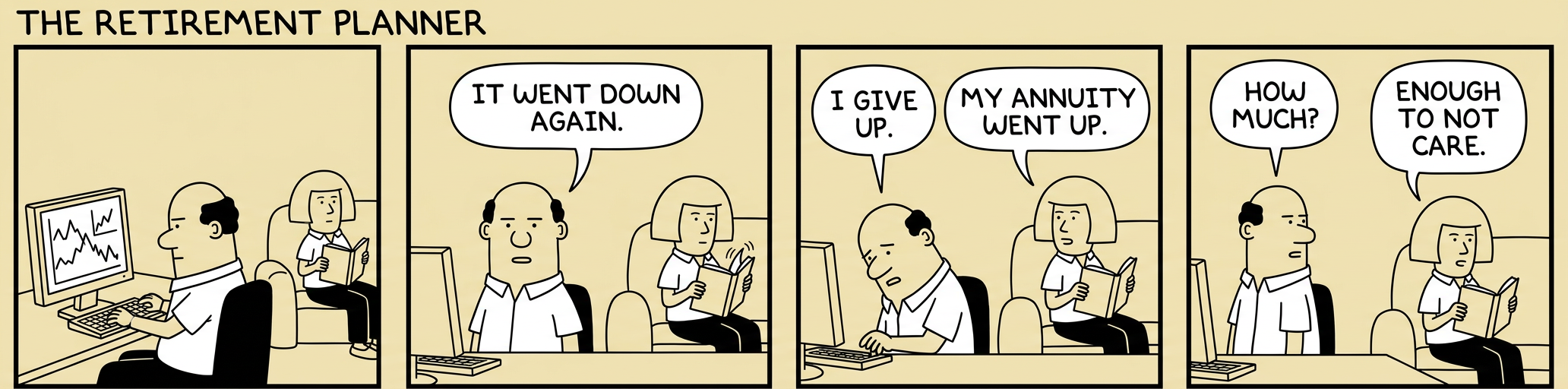
The Lighter Side of Compound Interest

A comic strip in four panels

Panel 1: A retiree lies in bed at night, eyes wide open. A clock on the nightstand reads 3:14 AM. A thought bubble says, 'Did I save enough?' Panel 2: He is now sitting up, illuminated by his phone screen showing his portfolio balance. His wife rolls over and says, 'Not again.' Panel 3: He stands at the refrigerator, eating cheese directly from the package, staring at a pie chart taped to the freezer door. Panel 4: Dawn breaks. He is finally asleep at the kitchen table, face resting on a calculator. His wife walks in with coffee and says, 'The market opens in two hours. Want me to wake you so you can worry in real time?'

From Worry to Blueprint: How to Turn 3 AM Fears Into a Daylight Plan


The antidote to financial anxiety is not more money. It is more clarity. Research from the RAND Corporation's Retirement and Disability Research Center consistently shows that retirees with a written financial plan report significantly lower anxiety and higher life satisfaction than those with equivalent savings but no formal plan. The plan itself — the act of naming the risks, quantifying them, and assigning a strategy to each — provides psychological benefits that go well beyond the financial mechanics.

A meaningful retirement plan addresses five questions explicitly. First: What is my guaranteed monthly income, and does it cover my essential expenses? Second: How long does my money need to last if I live to 90? To 95? Third: What is my plan for a major healthcare event or long-term care need? Fourth: What happens to my spouse financially if I die first? And fifth: Who is responsible for managing this plan, and how do I verify that they are acting in my interest?

The vetting of a financial advisor deserves its own process. Three questions cut through most of the noise. Ask whether they are a fiduciary — and ask them to put it in writing. Ask how they are compensated — fees, commissions, or both — and what conflicts of interest that creates. And ask for three references from clients in a similar financial situation. An advisor who is offended by these questions is an advisor who has answered your questions without saying a word.

It is worth acknowledging that no plan eliminates uncertainty entirely. Markets will fluctuate. Health will change. Costs will rise in ways no projection fully anticipates. The goal of planning is not to make the future predictable. It is to make it navigable. There is a meaningful difference between "I don't know what will happen" and "I don't know what will happen, but I have a plan for the most likely scenarios." The first keeps you up at 3 AM. The second lets you sleep.

Robert Haines pinned three numbers to his refrigerator: his guaranteed monthly income, his essential monthly expenses, and the gap between them. "That gap is the thing I can actually work on," he says. "The rest is weather. You can't control weather. But you can build a roof."


Editor's Pick

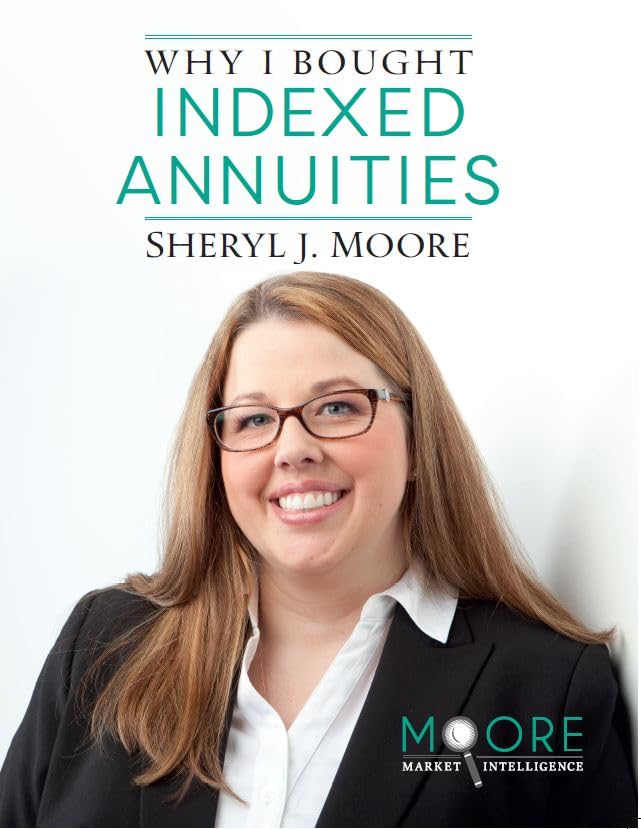
"Why I Bought Indexed Annuities"

Written by an independent industry analyst with no incentive to sell you anything — just a straightforward look at why she chose indexed annuities, what surprised her, and what she wishes more people understood. For readers who want facts, not a sales pitch.

Why I Bought Indexed Annuities - Free Book

Request Your Free Copy Below — No Cost, No Catch

Editorial Cartoons

Editorial cartoon: A retiree sits in a therapist's chair. The therapist's notepad reads 'Patient Fears: Running out of money, being a burden, trusting wrong advisor, that weird noise the furnace makes.' The therapist says, 'Let's start with the one that costs six figures per year if it breaks.' The retiree says, 'The furnace?' The therapist says, 'No. You.' Caption: 'The Retirement Session.'
Editorial cartoon: A fork in a road. One path is labeled 'Do Nothing (Free, For Now)' and leads to a cliff. The other is labeled 'Get Professional Help (Costs Something)' and leads to a modest but sturdy bridge over the same cliff. A retiree stands at the fork, arms crossed, saying, 'I don't trust bridges.' Caption: 'The Cost of Distrust.'

Extra! Extra!

Your Next Steps


  1. If you received this by email: Navigate back and click the booking link to schedule your free 60-minute education session.
  2. If you received this by text: Reply to your advisor and share what stood out to you. They will take it from there.
  3. Show up to your free education session. No obligations, no sales pitch — just annuity basics and answers to your questions.
  4. Receive your complimentary copy of "Why I Bought Indexed Annuities" — our way of saying thanks for your time.

"Education first. Decisions second. Always."


Classifieds

WANTED: Off switch for brain, effective between the hours of 2 AM and 6 AM. Must be compatible with retirement-aged models (1954-1971 vintage). Melatonin, chamomile tea, and counting sheep have been tried and found insufficient against compound-interest nightmares. Serious inquiries only.

Public Notices

NOTICE: The American Sleep Foundation, in partnership with the Bureau of Retirement Worrying, announces that 3 AM has been officially designated "National Retiree Portfolio Review Hour." All financial institutions are encouraged to disable mobile app access between 2 and 5 AM for the health and safety of their clients over 60.

Financial Forecast

OUTLOOK: The retirement planning industry is slowly shifting from an accumulation-only model to one that addresses the emotional and behavioral dimensions of retirement. Advisors who integrate behavioral coaching, transparent fee structures, and written financial plans are seeing higher client retention and satisfaction. For consumers, the signal is clear: the right advisor does not just manage your money. They manage your relationship with your money.